The program brings together international professionals from the remote work community, with the aim of promoting the region as an attractive destination for longer stays and remote work, while also strengthening the capacities of local tourism stakeholders.
The program involves a group of experienced digital nomads who will travel through Montenegro and Bosnia and Herzegovina over the course of a month, combining remote work with the exploration of local destinations.
“I am already two days into my multi-week journey as part of the STAR Nomad Residency program across Montenegro and Bosnia and Herzegovina. There is something about moving slowly through unfamiliar terrain, crossing borders, shifting rhythms, and adapting to new towns and rural environments every few days that strips away all abstractions. Over the next month, I expect that, together with my fellow STAR Nomad Residency participants, I will experience and document what it really looks like to operate effectively as a digital nomad on the ground: the practical challenges, unexpected advantages, and community hubs such as Code Hub, which serve as gathering points in Nikšić and Mostar, where digital nomads naturally connect. By mid-May, I hope to have a collection of stories, experiences, and practical insights worth sharing,” said Michael Cohen, one of the program participants.
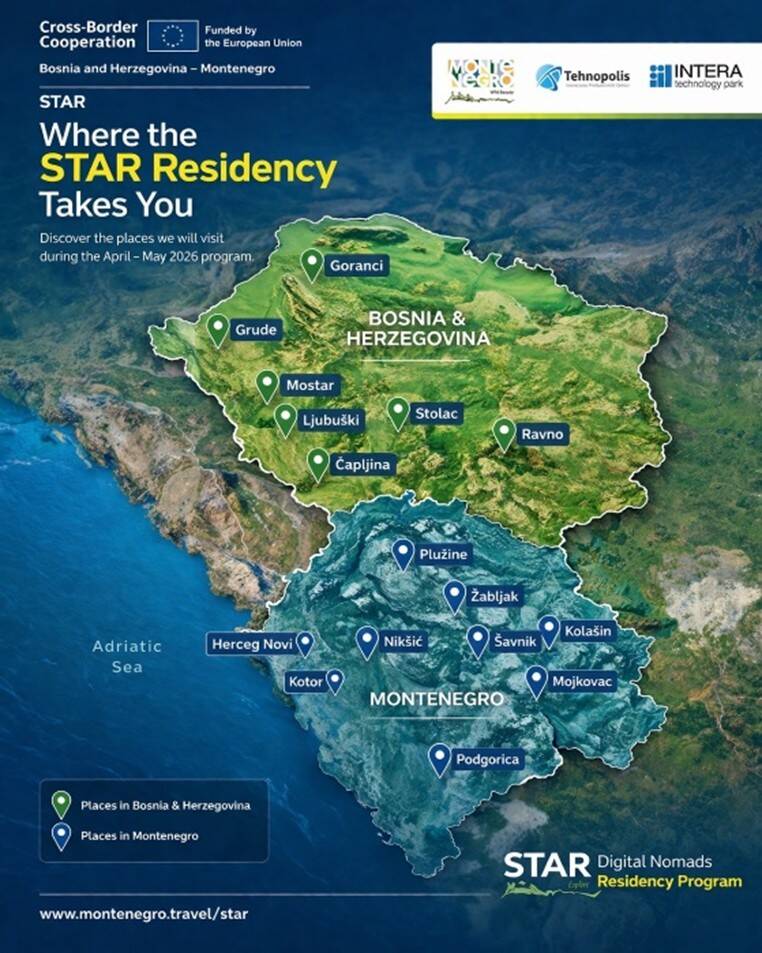
Their stay is focused on authentic experiences, ranging from natural beauty to cultural heritage, while using the services of local tourism operators and spending extended time in selected destinations. The itinerary is intensive and includes a number of locations in both countries. In Montenegro, the route covers Podgorica, Mojkovac, Kolašin, Šavnik, Žabljak, Plužine, Nikšić, Herceg Novi, and Kotor, while in Bosnia and Herzegovina it includes Ravno (Vjetrenica), Stolac, Čapljina (Hutovo Blato), Ljubuški, Mostar, and Grude. The aim of this approach is to showcase the diversity of the cross-border offer, while also presenting a realistic experience of living and working on the move.
The program is not designed as a traditional tourist trip, but rather as a combination of work, exploration, and content creation. Participants will share authentic stories and recommendations through their own channels, focusing on lesser-known locations and local service providers, thereby contributing to the long-term visibility of the destination.
Special emphasis is placed on gathering concrete insights into the needs of digital nomads, from infrastructure and accommodation to the overall quality of services and the experience of staying in the destination. These insights will serve as a basis for improving tourism products and better positioning the region in the global remote work market.
Through the STAR project, efforts are being made to strengthen the capacities of tourism operators, develop an innovative cross-border tourism product, and promote Bosnia and Herzegovina and Montenegro as destinations for sustainable travel and remote work.
The most interesting part of the program is expected to come from on-the-ground content, where participants will document their experiences and interactions with local communities, offering a different perspective on the region—one shaped by longer stays rather than short visits.
You can follow the journey, impressions, and recommendations of the digital nomads on the social media channels of INTERA and Tehnopolis, where their posts, photos, short videos, and visuals of the route and destinations are regularly shared.
The project is implemented by INTERA Technology Park in partnership with the Innovation and Entrepreneurship Center Tehnopolis and the National Tourism Organisation of Montenegro, within the IPA III CBC Programme Bosnia and Herzegovina – Montenegro 2021–2027.
Looking for ideas for your trip?
See how others experienced their time in Montenegro. We would love hearing from you - share your Montenegro moments with following hashtag: #gomontenegro.




Get ideas to your inbox: Sign up for newsletter